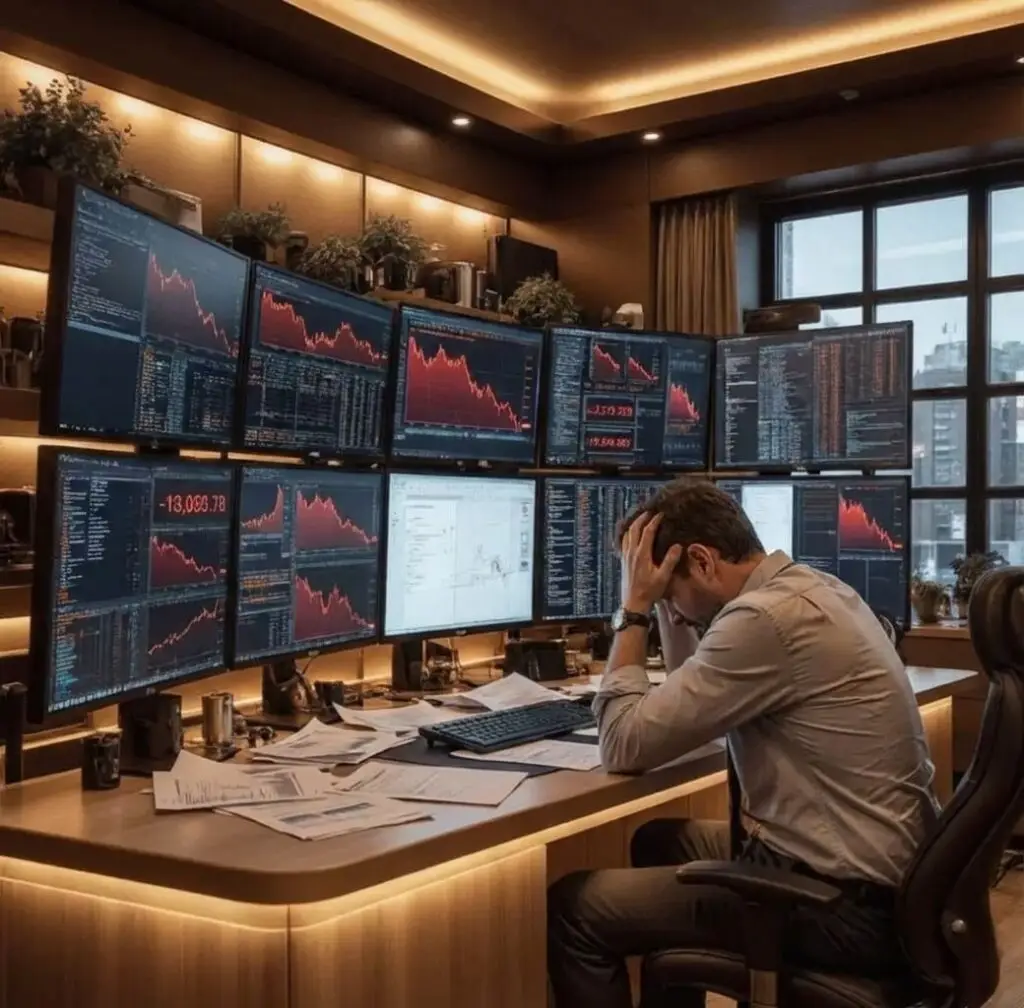
As a psychologist, my work is to unravel the complexities of human behavior, emotions, and decision-making processes. My experience has led me to treat individuals across diverse contexts, and some in the fascinating and revealing world of professional trading and cryptocurrencies. Here, in the arena of financial markets, psychology is not an add-on; it is the primary battlefield.
Success in trading transcends technical analysis. In fact, as elite trader Tom Hougaard points out, the vast majority of retail traders (between 80% and 90%) lose money not due to a lack of technical knowledge, but because they have not learned to think correctly in an environment of uncertainty. This is where my role as a psychologist becomes crucial. It’s not just about identifying the problems, but about applying validated therapeutic models, like Cognitive Behavioral Therapy (CBT), to actively restructure the mental patterns that lead to failure.
1) The Inner Battlefield: The Architecture of Our Irrational Decisions and Our Two Brains at War
To understand why we fail at trading, we must first abandon an obsolete idea: that of the purely rational investor. Behavioral economics, a field that integrates the fundamentals of cognitive psychology and neuroscience into economic analysis, has shown that our financial decisions are far from being perfectly logical. This approach breaks with the classical economic theory of homo economicus, an agent who always maximizes their utility in a calculated manner.
The resurgence of this field is largely due to psychologists Daniel Kahneman and Amos Tversky. Their 1979 paper, “Prospect Theory: An Analysis of Decision under Risk,” is considered the foundational publication of behavioral finance, as it used cognitive psychology to explain anomalies that rational theory could not justify (Kahneman & Tversky, 1979). Their work, along with the contributions of Nobel laureate Richard Thaler on limited rationality and lack of self-control, revealed that human behavior in the markets is, in fact, “predictably irrational” (Thaler, 2015).
Behavioral research identified three fundamental principles that explain why our decisions deviate from pure logic:
Heuristics (Mental Shortcuts): Our brain does not operate like a supercomputer. To save energy, it often makes decisions using rules of thumb or intuitive “shortcuts” instead of rigorous analysis. An example is the availability heuristic, where we judge the probability of an event by the ease with which we recall similar examples (Kahneman, 2011). In trading, if we have just seen several news stories about the success of a cryptocurrency, our brain will overestimate its probability of continuing to rise, ignoring the actual statistics.
Framing: The way a problem is presented to us drastically affects our decision, even if the options are logically identical. For example, a trader is more likely to close a position if it is framed as “locking in an 80% gain” than if it is framed as “giving up a 20% potential gain.” This framing effect exploits our emotional responses and is a direct challenge to the assumption of rationality.
Market Inefficiencies: These cognitive biases, magnified at a collective level, explain why markets are not always efficient. Panic, euphoria, and speculative bubbles are not anomalies, but manifestations of human psychology.
The brain mechanism underlying these principles is the two-system model (Kahneman, 2011):
System 1 (the automatic pilot): Fast, intuitive, and emotional. It is responsible for heuristic-based responses and is influenced by framing. In trading, it is the source of fear, greed, and the impulsive decisions that lead to disaster.
System 2 (the logical thinker): Slow, deliberative, and analytical. It is what we use to design a trading plan and execute it with discipline.
The fundamental problem is that System 2 is inherently “lazy.” When the market moves sharply, System 1 takes control with an immediate emotional response, and often System 2 does not intervene to correct it. The profitable trader is not necessarily smarter, but has trained their System 2 to supervise and override the destructive impulses of System 1.
2) The Neurobiology of Risk: Why Losing Hurts So Much
Neurotrading allows us to observe these processes in real-time by measuring brain activity. Emotional decisions activate the limbic system, while reasoning and impulse control reside in the prefrontal cortex (Kahneman, 2011).
The most powerful bias that sabotages traders is Loss Aversion (Kahneman & Tversky, 1979). Neurobiologically, the pain of a loss is approximately twice as intense as the pleasure of an equivalent gain (Thaler, 2015). Our brain is wired to respond to threats (losses) with more urgency than to opportunities (gains).
This manifests as the “Disposition Effect”: the universal tendency to sell winning positions too soon and hold losing positions for too long (Swiset, 2025). This behavior is surprisingly similar to that observed in addictive disorders, such as pathological gambling, where loss of control and impulsivity are mediated by the same brain reward system that seeks to avoid pain and pursue immediate gratification (Bueno et al., 2018; Coloma-Carmona et al., n.d.).
3) The Therapeutic Approach: Applying Cognitive Behavioral Therapy (CBT) to Trading
If cognitive biases are the “software bugs” of our minds, Cognitive Behavioral Therapy (CBT) is the debugging process. CBT focuses on identifying and modifying the automatic thoughts and cognitive distortions that make us vulnerable to uncontrolled behaviors. It has demonstrated enormous efficacy in reducing the severity of addictions and stress, strengthening the self-control of System 2 to override the impulses of System 1 (Baenas Soto & López Trabada, 2019).
Here is how, from my perspective as a psychologist, we apply the principles of CBT to diagnose and treat the patterns that sabotage your trading:
There are countless biases, but three are particularly destructive and interconnected by fear and a lack of impulse control:
The Illusion of Control: This is the erroneous belief that we can influence the outcome of events that are largely random. In trading, it manifests as the desire to “catch every pip in the market.” This illusion leads directly to overtrading, because every missed move is perceived as a personal failure, not statistical noise.
FOMO (Fear Of Missing Out): This is a powerful social and emotional anxiety. You see an asset soaring, read about it on social media, and your System 1 screams that you are missing the opportunity of a lifetime. This impulse makes you abandon your plan and enter a trade without a rational basis.
Retroactive FOMO (Revenge Trading): This is a toxic combination of regret and loss aversion. You missed a trade you had analyzed that turned out to be profitable. The pain of that “missed opportunity” is so great that you enter late and with poor risk management on the next signal, driven by an emotional need to “get back” what you never had.
4) The Therapeutic Antidote: Tools to Rewire Your Trader Brain
The result is almost always a real loss, which fuels a cycle of frustration and revenge trading against the market. If you recognize yourself in this pattern, do not worry; it is an incredibly common human response. The good news is that, as a psychologist, I know that these patterns can be unlearned. Below, I present the therapeutic tools I use to help you rewire your brain for trading.
CBT Intervention 1: The Trading Journal as a Cognitive Mirror.
This is not just a logbook; it is a clinical introspection tool. I guide you to record your automatic thoughts and emotions at the moment of entry and exit (“I felt anxious seeing the candle rise, I thought I was missing out,” “I had to make back the previous loss”). This allows us to identify these patterns in black and white, which is the first step to changing them.CBT Intervention 2: The “Mental Pause” Technique.
Before any impulsive decision, we implement a mandatory 30-second pause. During this pause, you train yourself to ask a key question: “Is this decision based on my plan, or on an emotion like fear or hope?” This simple action is a behavioral “short-circuit” that activates the prefrontal cortex and brings you back to System 2.
As we have seen, the pain of a loss is disproportionate. This pain, combined with the ego (the need to be right), is what makes you hold losing positions far beyond your stop-loss. You do not want to “accept” the mistake, so you transform a small, controlled loss into a catastrophe for your account.
CBT Intervention 3: Cognitive Restructuring.
Here, we actively work to challenge and replace your irrational beliefs about loss.Distorted thought: “If I close this trade in the red, I will have failed.”
Rational restructuring: “Closing this trade at the point defined by my stop-loss is the definition of success. It means I am executing my plan with discipline. A loss is an operating cost, not a reflection of my worth.”
CBT Intervention 4: Systematic Desensitization to Pain.
This is an exposure technique. I guide you to trade with a risk so low that the pain of loss is almost imperceptible. By repeatedly experiencing small losses and seeing that they are not catastrophic, your brain begins to desensitize. Gradually, as your tolerance increases, we can scale the risk in a controlled manner.
Trading is a high-stress activity. Anxiety and frustration can build up, leading to erratic decision-making and mental fatigue.
CBT Intervention 5: Emotional Regulation Training.
We incorporate validated stress management techniques, such as diaphragmatic breathing and mindfulness (Balosa Millán et al., 2019; Llorente Vizcaino et al., 2019). These practices are not “magic”; they are neurocognitive training exercises that have been shown to reduce the activation of the sympathetic nervous system (the “fight or flight” response) and improve the ability to maintain calm and clarity under pressure.
5) Conclusion: Your Mind is Your Competitive Edge
Trading is one of the most psychologically demanding performance fields. You are not fighting the market; you are fighting millions of years of evolution that have programmed you to react impulsively to risk and reward.
Technical knowledge is the foundation, but it is insufficient. The true, sustainable edge comes from mastery over your own mind. As a psychologist specializing in this field, my goal is to provide you with the clinical, evidence-based tools to build the mental fortitude necessary not only to survive, but to thrive in the markets.
Mastering your mind isn’t an option; it’s the only path to mastering the market.
Bibliography
Arias Bisang, C. (2023). Optimización del diagnóstico psicológico a partir de estrategias cognitivas de reorganización del conocimiento en estudiantes de… [Optimization of psychological diagnosis based on cognitive strategies for knowledge reorganization in students of…]. [Final Degree Project]. Pontificia Universidad Católica Argentina.
Baenas Soto, G., & López Trabada, J. R. (2019). Eficacia de la terapia cognitivo-conductual en el estrés percibido en pacientes con trastorno por uso de sustancias [Efficacy of cognitive-behavioral therapy on perceived stress in patients with substance use disorder]. [Poster presentation]. XXIII National Conference of Socidrogalcohol, Seville, Spain.
Balosa Millán, M. J., Infante Fonte, E., Ruiz Barroso, M. T., Castro Travé, G., & Fernández-Calderón, F. (2019). Ansiedad, ira y estrategias de afrontamiento en pacientes con trastorno por juego de apuestas [Anxiety, anger, and coping strategies in patients with gambling disorder]. [Poster presentation]. XXIII National Conference of Socidrogalcohol, Seville, Spain.
Bueno, F. J., et al. (Eds.). (2018). Jornada “Las ludopatías irrumpen en el tratamiento de las adicciones” [Conference “Pathological gambling bursts into addiction treatment”]. Pla Municipal de Drogodependències, Ajuntament de València.
Coloma-Carmona, A., Carballo, J. L., Miró-Llinares, F., Aguerri, J. C., & Rodríguez-Espinosa, S. (n.d.). Distorsiones cognitivas sobre el juego en población española que apuesta en nuevos formatos [Cognitive distortions about gambling in the Spanish population betting in new formats]. [Poster]. CONGRESS SOCIDROGALCOHOL.
El psicólogo del trading. (n.d.). En 20 minutos no volverás a tener MIEDO a perder dinero en tu trading [In 20 minutes you will no longer be AFRAID of losing money in your trading] [Video]. YouTube.
Kahneman, D. (2011). Thinking, fast and slow. Farrar, Straus and Giroux.
Kahneman, D., & Tversky, A. (1979). Prospect theory: An analysis of decision under risk. Econometrica, 47(2), 263–291.
Llorente Vizcaino, A., Real López, M., Sánchez Hervás, E., & Carpeño, R. (2019). Prevención de recaídas en adicciones comportamentales mediante un programa de intervención grupal basado en mindfulness [Relapse prevention in behavioral addictions through a mindfulness-based group intervention program]. [Oral communication]. XXIII National Conference of Socidrogalcohol, Seville, Spain.
OKX LATAM. (n.d.). Domina la psicología del trading y tus emociones al operar en el mercado cripto [Master trading psychology and your emotions when operating in the crypto market] [Video]. YouTube.
Rubén Martínez. (n.d.). La PSICOLOGÍA en el TRADING ALGORÍTMICO (Cómo Afecta) [The PSYCHOLOGY in ALGORITHMIC TRADING (How it Affects)] [Video]. YouTube.
Swiset LLC. (2025). Mente sobre mercado: Cómo el neurotrading y el psicotrading mejoran la toma de decisiones en el trading [Mind over market: How neurotrading and psychotrading improve decision-making in trading]. [Excerpts].
Thaler, R. H. (2015). Misbehaving: The making of behavioral economics. W. W. Norton & Company.
UnEspeculadorMas. (2024). Psicología del trading — Ideas de trading en TradingView [Trading psychology — Trading ideas on TradingView]. (Excerpts from TradingView articles).
Universidad Torcuato Di Tella. (2014). Ciclo de Finanzas Avanzadas | Neurociencia y decisiones de trading [Advanced Finance Series | Neuroscience and trading decisions] [Video]. YouTube.

Psychologist Col. 26.978 and founder of the Centre de Psicología Jaume Primer – Psicòlegs Girona.